19 October 2026 · By Hadi Ataei
AI in Health and Fitness: What It Does Well and Where to Be Careful
If you have used a fitness app, a smartwatch or a calorie counter recently, you have already used AI for your health. It picks the workout, guesses what is on your plate and tells you how well you slept. Some of that is genuinely useful. Some of it is a confident guess. This article explains what the AI is actually doing in each case, so you can tell the two apart.
Why this matters now
The World Health Organization estimates that nearly one third of the world's adults, about 1.8 billion people, do not reach the recommended minimum of 150 minutes of moderate physical activity a week. Its guidelines also stress that any amount of activity is better than none, and that muscle strengthening benefits everyone. The hard part for most people is not knowing what exercise is good; it is starting, planning and keeping going. That is exactly the gap that apps try to fill with AI.
What AI is doing inside a fitness app
Most of what is sold as "AI" in health and fitness is one of four things.
- Planning. You give the app a goal, your equipment and how much time you have. A model, often a language model working inside rules written by the app's developers, turns that into a workout or a weekly meal plan. If you log your results, the app can raise or lower the weights next time. (For how language models work, see What Is a Transformer?)
- Recognition. A computer vision model looks at a photo of your meal, or the barcode on a packet, and guesses what the food is and how much of it there is. This is the same kind of image model that powers face unlock and photo search.
- Sensing. Watches and bands measure your pulse with light sensors and your movement with motion sensors, then use models to turn those signals into steps, heart-rate zones and sleep stages.
- Summarising. A model reads your week of logged data and writes a short summary or suggestion, like a coach's weekly note.
None of these are medical diagnosis. They are pattern matching on the data you give them, which is why the quality of that data matters so much (see Dirty Data Will Wreck Your AI Project).
Where it helps
Removing the planning friction. Deciding what to do in a 30-minute session with two dumbbells is a real barrier. Having a plan generated for you, and adjusted as you improve, makes it easier to simply show up. Tracking consistency. Streaks, trends and weekly summaries show you what you actually did, which is often different from what you remember. Personalising to your situation. A good tool starts from your goal, your equipment and your schedule instead of a one-size-fits-all programme.
Where it can mislead you
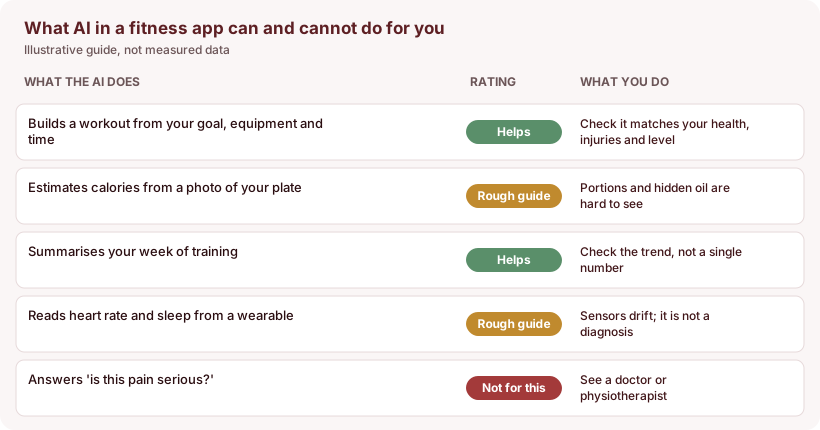
- Food photos are estimates. A camera can usually tell rice from bread, but it cannot see how much oil went into the pan or what is hidden in a sauce, and portion size is hard to judge from one angle. Treat the calorie number as a rough guide and look at the trend over weeks, not one meal.
- Language models can sound sure and be wrong. A chatbot will happily write you a training plan or answer a health question in fluent, confident text. It does not know your medical history, and it can invent details. A plan that looks reasonable can still be too much for you.
- Wearable readings are approximate. Optical heart-rate sensors can be less reliable during fast, irregular movement, and sleep stages are inferred rather than measured directly. They are good for your own trends, not for deciding whether something is wrong with you.
- The advice is only as good as the data it learned from. If a model was trained mostly on one kind of user, its suggestions may fit others less well. Why a model gives the answer it does is often hard to see; we explain that in Why Are AI Models Like Black Boxes?
- Your health data is sensitive. Weight, meals, sleep and location say a lot about you. Check what an app stores, whether you can delete your account, and who it shares data with.
Context is the missing piece: an example from our own work
One reason generic fitness advice fails is that it ignores how people actually live. Take Ramadan. Many people keep training while fasting, usually with shorter or lighter sessions or after iftar, and meals shift into two windows, suhoor and iftar. A planner that does not know this will schedule the wrong workout at the wrong time. Building that context in, along with halal food and Arabic on-screen, is a design choice, not an AI breakthrough, but it is what makes the AI's output usable.
Disclosure: Sihha Fit is another project from the team behind Qatar AI Institute, so this is an example from our own work, not an independent review. It is an Islamic fitness app that generates workouts from your goal, equipment and time, builds 7-day halal meal plans, logs food from a photo or barcode, and includes a Ramadan mode with suhoor and iftar meal slots. It is available in English and Arabic. Its Ramadan workout plan guide is a practical starting point if you want to train while fasting. As with any such app, if you have a medical condition, speak to your doctor first.
A simple way to use AI for health safely
- Use it for planning and consistency, not diagnosis. Let it suggest a session or summarise your week. Do not ask it whether a symptom is serious.
- Start lighter than it suggests. If a plan feels too hard, it is. Adjust it, and stop if something hurts.
- Watch trends, not single numbers. One odd calorie estimate or sleep score means little. A month of data means more.
- Tell it the truth. The output is only as good as the goal, equipment, injuries and habits you enter.
- See a professional for anything medical. That includes chest pain, dizziness, a persistent injury, pregnancy, diabetes or any condition you are managing, and it applies especially before fasting or a big change in diet or training.
- Check the privacy policy. Know what is stored and how to delete it.
What it means if you want to work in this area
Health and fitness is one of the most practical places to apply machine learning: time-series signals from sensors, computer vision for food and movement, and language models for coaching and summaries. It also demands care, because mistakes affect people's bodies. If you want to build these skills, start with the foundations in our Machine Learning Fundamentals course, and read how AI is already working in other industries in these industry case studies. For a look at AI in biology, see our review of AlphaGenome.
This article is general information, not medical advice. Source for the activity statistics: WHO physical activity fact sheet. Sihha Fit details are from sihhafit.com.