6 October 2026 · By Hadi Ataei
ALoDLM: A Language Model That Thinks Longer on Hard Words
Every chatbot you use today writes one token at a time, left to right. A newer family of models, diffusion language models, tries something different: fill in many tokens at once. They are fast, but so far they have usually been less accurate than ordinary models of the same size. A paper submitted to arXiv on 3 October 2026, "ALoDLM: Adaptively Looped Diffusion Language Models", claims to close that gap with a simple idea: spend more computation on the hard tokens and less on the easy ones. It was one of the most upvoted papers on Hugging Face's daily papers list on 6 October, so it is a good one to read closely.
Background: two ways to write text
An autoregressive (AR) model, which is what GPT-style and most chatbot models are, predicts the next token, appends it, and repeats. (Our article What Is a Transformer? explains the machinery.) The cost is that each step has to wait for the one before.
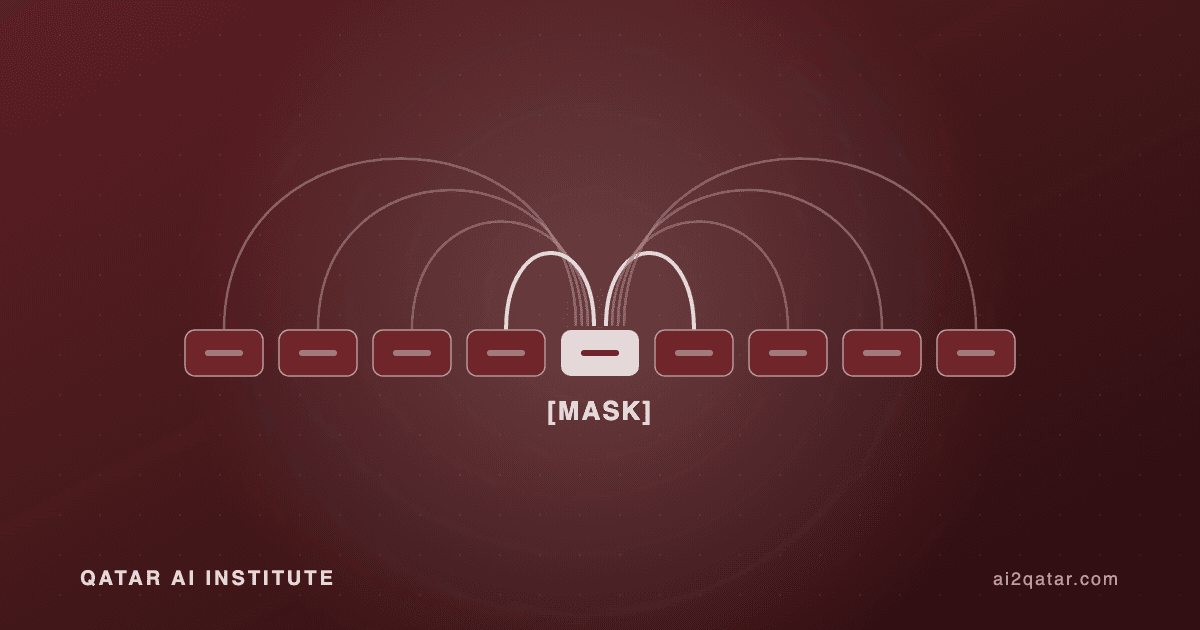
A masked diffusion language model (DLM) starts from a sequence in which some positions are hidden behind a [MASK] symbol. At each denoising step the model looks at everything it knows and predicts all the blanks in parallel, then keeps some predictions and tries again. Predicting several tokens per step is what makes it fast. Think of filling in a crossword rather than writing a sentence.
![Three panels. 1: an autoregressive model predicts one token per step. 2: a masked diffusion model fills several [MASK] blanks in the same pass. 3: ALoDLM gives easy tokens one pass through the model's layers, a medium token two passes, and a hard token up to four passes.](/articles/alodlm/1-token-adaptive-passes.svg)
The problem the authors point to
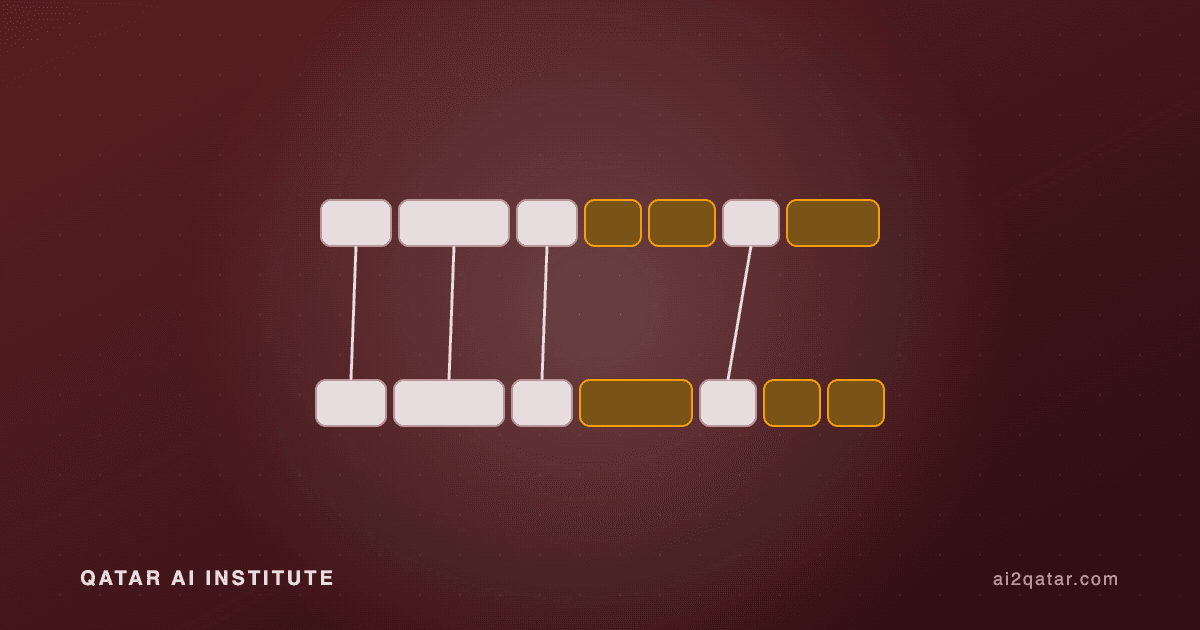
The authors argue that DLMs lose accuracy because of a computation-difficulty mismatch. Among the blanks in a partly filled sentence, some are trivial (a closing bracket, a common word) and some are hard (a number in a calculation, a rare name). Yet a standard DLM runs the same amount of computation, the same number of layers, on every blank at every step. That wastes effort on easy tokens and starves the hard ones.
The idea: loop the middle of the network, per token
ALoDLM splits the Transformer into three parts: a prelude (embedding and a few early layers), a recurrent core (the middle layers), and a coda (the final layers). Inside each denoising step, the core can be run again and again on the same hidden representation. This is called latent recurrence, or "looping", because the model refines its internal state instead of emitting a token straight away.
The twist is that looping is token-adaptive:
- After each pass, any token whose prediction is confident enough (low entropy, below a threshold) is committed as a normal discrete token and fed back as context.
- Unresolved tokens keep their hidden state and get another pass.
- A small learned exit gate outputs, for each token and pass, a probability of stopping. The loop ends when every token has committed or the average stop probability crosses a threshold, and it is capped at four passes.
The authors report an interesting side effect: numerical tokens had the lowest stop probability (0.369, against a mean of 0.417 across datasets), meaning the model learned on its own to keep working longer on numbers, without anyone labelling which tokens are hard.
How it is trained
The tricky part is teaching the model how long to think while it also learns what to predict. The authors treat each token's exit depth as a hidden (latent) variable and derive a training objective from a variational bound, a conditional negative evidence lower bound (NELBO). Because summing over every possible exit schedule is intractable, they use a score-function (REINFORCE-style) gradient estimator, plus variance-reduction tricks: supervising the predictions at all earlier depths, and subtracting a baseline. In the paper, the first of these lowers gradient variance by 1.76 times at training step 1,000.
Notably, the models were converted from existing Qwen3 backbones with supervised fine-tuning on about 5 billion tokens, rather than trained from scratch or given a long continued-pretraining phase. That makes the approach cheaper to reproduce.
What the results say
The authors trained 1.7-billion and 8-billion-parameter versions and evaluated on eleven benchmarks covering reasoning, knowledge, maths and coding (including ARC, MMLU, GPQA, GSM8K, MATH-500, MBPP and HumanEval). As reported in the paper:
- Accuracy: the 8B model averaged 80.3 versus 78.5 for the Qwen3-8B autoregressive baseline, and 75.1 for WeDLM-8B, another diffusion model. The 1.7B model averaged 65.5 versus 63.8 for Qwen3-1.7B. It beat the AR baselines on all four coding benchmarks.
- Speed: at about 93% accuracy on GSM8K, it produced 612 tokens per second versus 564 for WeDLM, with roughly 14% fewer arithmetic operations per token. The authors say this is about 2.7 times the throughput of the Qwen3-8B model served with vLLM at comparable accuracy.
- Test-time scaling: raising the exit threshold made the model loop more (1.6 to 2.34 passes per token on average) and lifted the average score from 77.9 to 79.1, so you can trade speed for accuracy without retraining.
Caveats worth keeping in mind
- These are the authors' own numbers on their chosen benchmarks. This paper is a preprint and has not been through peer review, and independent replication will matter.
- The authors state two limitations: a longer time to first token, because the loop makes the prompt-processing stage heavier (a drawback for short, latency-sensitive replies), and speed that depends on the input. On domains where the model is less confident, its speed advantage could shrink or reverse.
- The headline comparison is against Qwen3 baselines of the same size. It does not show that diffusion models beat every autoregressive model.
Why it matters if you are learning AI
Three ideas here are worth learning independently of this one paper. First, adaptive computation: not every input deserves the same effort. Second, recurrence in depth: reusing layers, rather than adding new ones, to "think" longer. Third, latent-variable training: the variational bounds behind it are the same family of tools used in VAEs and classic diffusion models. If you understand attention (see What Is a Transformer? and What Is BERT?, which also predicts masked tokens), you are most of the way to reading this paper. To build that foundation, try our Introduction to Natural Language Processing course.
What to watch next
- Independent reproductions on other benchmarks and model sizes.
- Whether the time-to-first-token cost can be reduced for chat-style use.
- Whether other diffusion language models adopt per-token adaptive depth.
Sources: arXiv:2610.04198 (submitted 3 October 2026, cs.AI / cs.LG) and its full-text version. The authors list code at github.com/amazon-science/ALoDLM and a model at huggingface.co/amazon/ALoDLM-8B. This is an independent explainer, not written by the paper's authors.