15 October 2026 · By Hadi Ataei
Meta's Muse Wonder: What Its First Frontier Models Are Built For
On 12 October 2026, Meta announced Muse Wonder and Muse Wonder Full, which it calls its most capable AI models to date. The company says they are built for "personal and professional agentic tasks": jobs where an AI has to read documents, remember what matters to you and keep working through a multi-step task. They follow Meta's earlier Muse Spark models and come after what Meta describes as a ground-up overhaul of its AI efforts that began fourteen months ago. This article explains what Meta announced, what its main claims mean, and what to wait for before judging them.
What was announced
- Two models: Muse Wonder and Muse Wonder Full.
- Availability: Muse Wonder is available now to developers through the Meta Model API and through Muse Code, a Meta product for coding. Muse Wonder Full is available to Muse Code subscribers. Meta says Muse Wonder will soon power more experiences in Muse, Meta's personal AI product, rolling out first to subscribers.
- Training: Meta says the models were trained at its gigawatt-scale Prometheus data center.
- Focus areas: expert domains such as law, finance and health (one evaluation named is Harvey's Legal Agent Benchmark), and "frontier coding", from small apps to larger projects.
- Weights: the announcement describes access through the API and Muse Code. It does not mention releasing the model weights.
The two features Meta is highlighting
Active Memory is Meta's name for carrying what matters about you across conversations and bringing back the details that are relevant to the task at hand. Active Focus is the ability to keep working towards a goal when a task gets hard: trying other approaches, recovering from errors, asking for clarification when needed and checking in before doing anything important. Meta says it measures these with evaluations called FocusBench and SWE-Marathon, the latter testing long-running software projects.
Both features address a known weakness of AI agents. Agents tend to lose track of earlier information and to give up or drift on long tasks. Our article on Learn2Play Bench shows why memory is a hard design question: in that study, how an agent stored its past experience changed how well it learned.
The claim worth understanding: generalisation
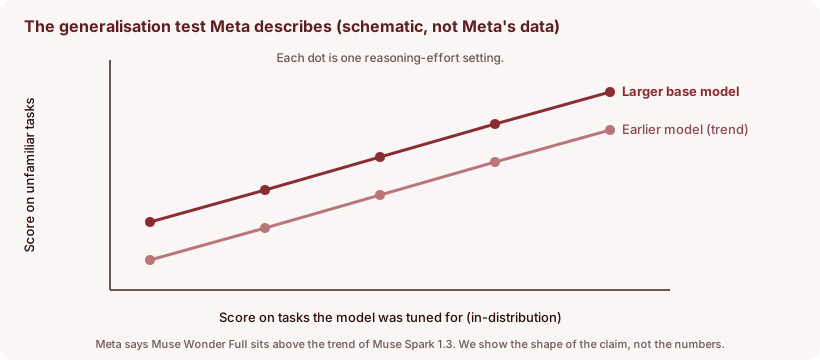
Meta's research post raises a familiar problem. Two models can have similar benchmark scores, yet one seems to handle a much wider range of unfamiliar tasks. Online, people call the first problem "benchmaxxing" (tuning a model to the popular tests) and use "big model smell" for the second feeling of broad capability. To put a number on this, Meta compares performance on tasks it targeted during post-training ("in-distribution") with performance on tasks it did not target ("out-of-distribution"), at different amounts of reasoning effort. It says Muse Wonder Full scores higher on unfamiliar tasks than the trend of its earlier model, Muse Spark 1.3, would predict, and it attributes this to a larger, stronger base model, whose post-training gains carry over better.
It is a sensible test, and a useful idea to keep in mind when you read any model announcement. But it is Meta's own measurement on a task set Meta chose.
What Meta says about safety
Meta says it trained the Muse Wonder family to avoid sharing private information without permission, to turn down requests that would help with clearly harmful acts, and to help strengthen defences against cyber attacks while still being able to help developers find flaws in their own code. It says the models are trained, evaluated and released in line with its Meta Superintelligence Scaling Framework, and that a full report with additional safety evaluations will be available soon. That report had not been published when we wrote this.
How to read the claims
- The benchmark results are Meta's own. Meta says the models reach state-of-the-art results on key benchmarks for personal and professional agents, memory and coding. The detailed comparison is in charts in its post, and we have not reproduced the numbers. Wait for independent tests.
- "Personal superintelligence" is a marketing phrase. Meta uses it for its direction of travel. It is not a measured capability.
- The safety evidence is still to come. For models meant to act across your messages, calendar and documents, the promised safety report matters more than the benchmark chart.
Why it matters
Meta became widely known for releasing open-weight models. This announcement describes access through an API and Meta's own products, and it does not mention weights. That is worth watching for developers who built on Meta's earlier open models, and it contrasts with open-weight releases such as Mistral Large 4. It also shows where the industry is competing now: not on chat quality alone, but on agents that remember, persist and act.
What it means if you are learning AI
The skills behind agents are the ones in the foundations: language models, reinforcement learning from feedback, evaluation and safety. If you want to build or judge such systems, start with Introduction to Natural Language Processing and our AI Ethics and Bias course. A good habit is to separate what a company says its model can do from what independent tests show.
What to watch next
- Meta's full safety report, and whether outside researchers can reproduce its evaluations.
- Independent benchmarks of Active Memory and Active Focus on real tasks.
- Whether Meta releases any weights, and what developers will pay for API access.
Sources: Meta newsroom: Introducing Muse Wonder and Muse Wonder Full, 12 October 2026; Meta AI research blog: Muse Wonder, 12 October 2026.