20 October 2026 · By Hadi Ataei
OpenAI Targets COBOL and Fortran: AI Coding Beyond Python
On 19 October 2026, OpenAI published a post titled Advancing coding in low-resource programming languages. Its claim is that the company's latest models are now far better at building and migrating software in languages such as COBOL, Fortran and Visual Basic, which have much less public code and documentation than Python or JavaScript. It backs the claim with two new tests and some large jumps in score. This article explains what was measured, what the numbers say and what they do not say.
What "low-resource" means
A language model learns to write code by reading a huge amount of it. Python and JavaScript have enormous amounts of public code, tutorials and discussion. COBOL, Fortran and similar languages have far less, so models have had less to learn from, and they have tended to do worse. (For how models learn from text, see What Is a Transformer?)
That matters because these languages are not obscure in practice. OpenAI cites IBM for the figure that COBOL supports more than 40% of online banking systems, 80% of in-person credit card transactions and 95% of ATM transactions, and says Fortran is used in weather forecasting and nuclear reactor safety analysis. It also notes why the software is hard to maintain: documentation may be incomplete, the original developers may have left, and important business rules may exist only in the code.
The two tests OpenAI built
- MultiLangBench. The model must build a SQLite-compatible database engine from scratch in a language it is told to use, across 20 languages. It has to organise a codebase, manage state, handle errors and add features without breaking what already works. To compare languages fairly, every program reads a database file and a SQL query and writes a changed database file, and the reference SQLite checks the result. The tests are adapted from SQLite's own test suite. OpenAI says it is releasing the setup and test suite on GitHub.
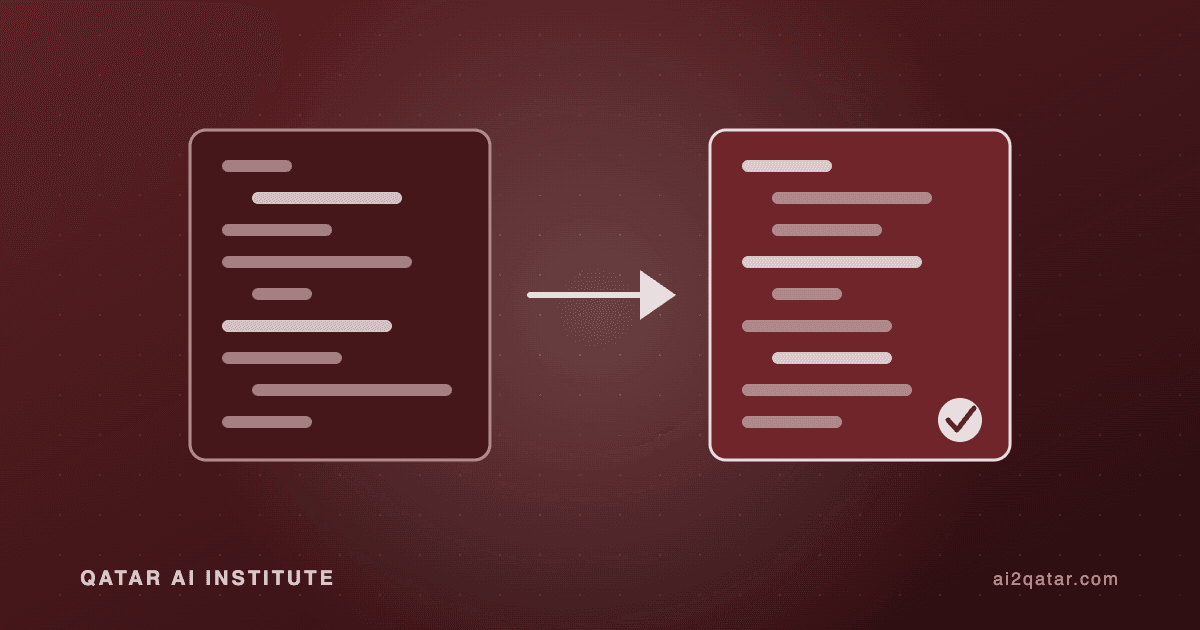
- A COBOL migration evaluation. The model must migrate existing COBOL programs to C++, Java, Kotlin, Python or Rust while preserving what they do. Hidden tests require byte-for-byte identical output, and a migration counts as a success only if every test passes.
The results OpenAI reports
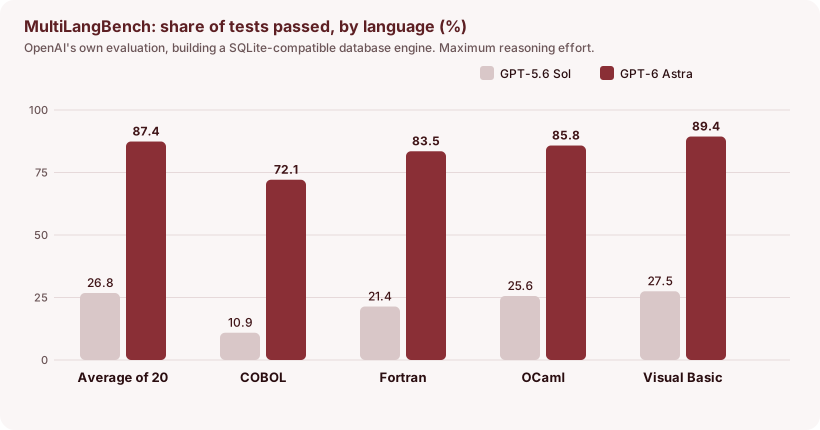
- Building from scratch. GPT-6 Astra passes 87.4% of tests on average across the 20 languages, up from 26.8% for GPT-5.6 Sol, with gains in every language tested. It scores above 83% in 19 of the 20 languages. COBOL remains the hardest, at 72.1%, though that is up from 10.9%.
- A cheaper model. GPT-6 Luna averages 40.3%, also better than GPT-5.6 Sol in every language, at an estimated $0.77 per sample against $3.48, about 78% lower.
- Migrating COBOL. GPT-6.1 Sol reaches 86.6% accuracy at low reasoning effort, compared with 5.4% for GPT-5.6 Sol, at 61% of the cost. At higher reasoning effort it reaches 97.9%, which OpenAI says nearly saturates the evaluation.
Why migration is harder than it looks
OpenAI gives one example. COBOL's fixed-point arithmetic discards extra decimal digits unless rounding is explicitly requested. A rewrite that rounds instead can run without any error and still produce different financial results.
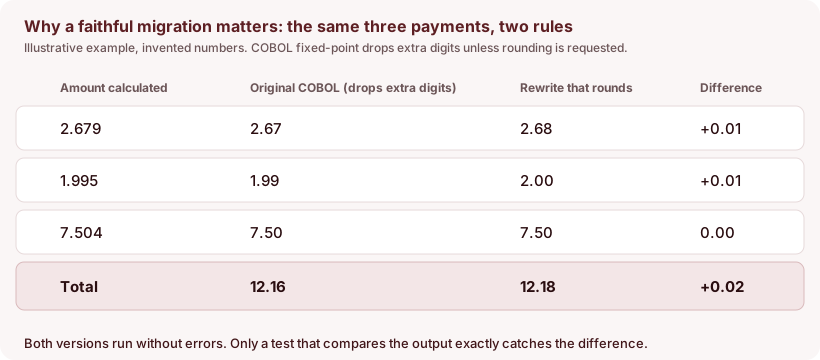
This is why the migration test demands exact matches on hidden tests. "It compiles and runs" is not the standard; "it behaves the same" is.
How to read these numbers
The following points are our reading, not OpenAI's:
- The benchmarks and the scores are OpenAI's own. The MultiLangBench setup is being released, which lets others check it. We have not seen independent results yet.
- A benchmark is not a bank. SQLite has a clean specification and a reference implementation to check against. A real legacy system has decades of undocumented behaviour, odd data formats and surrounding systems. OpenAI itself says that applying this to production software still needs expert review and testing against the system's business rules.
- A nearly saturated test is nearly used up. At 97.9%, the COBOL migration test can no longer tell strong models apart, so harder tests will be needed.
- The headline gains compare against an older model. The jump is from GPT-5.6 Sol to the new models, and the large factor is partly because the older model started so low.
What it means if you are learning AI or software
Two practical lessons. First, tests are the skill that scales: both of OpenAI's evaluations work because there is an exact, automatic check for whether the behaviour is preserved. Writing good tests, and knowing what "the same behaviour" means, is exactly what a person still has to supply. Second, understanding older systems is becoming a task people and AI tools do together: the model drafts the migration; a person who understands the business rules reviews it. For more on AI coding agents, see our explainer on how a coding agent can drive a robot, and on why builders matter more than users, Using AI Is the Baseline, Building It Is the Edge.
What to watch next
- Whether independent teams reproduce the MultiLangBench results from the released test suite.
- Whether other model makers publish results on the same languages.
- How companies report real legacy migrations, and how many errors reviewers catch.
Sources: OpenAI, Advancing coding in low-resource programming languages, 19 October 2026. All figures are from that post unless marked as our reading.