
Robot Motion Planning I: Graph Search Methods
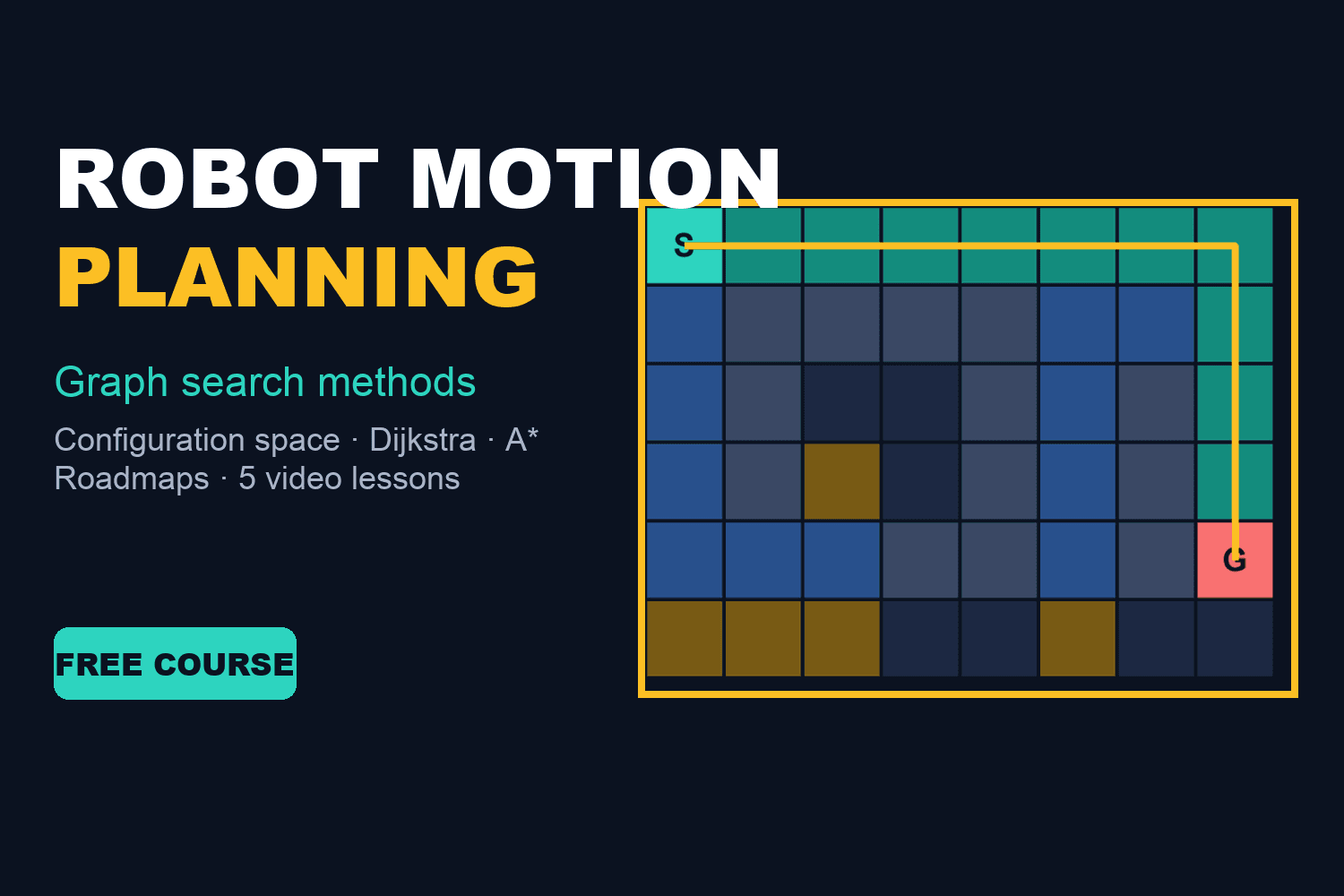
A free video course on how a robot finds a collision-free path: configuration space, grid search with Dijkstra and A*, and roadmaps. No robotics background needed.
How does a robot get from here to there without hitting anything? This free course answers that question. You learn why planning happens in configuration space, how a grid turns the problem into a graph search, why A* beats Dijkstra, and how exact roadmaps work when grids break down.
What you will learn
- Configuration space: shrinking the robot to a point and growing the obstacles
- Why angles wrap around, and what that does to a planner
- Label-correcting algorithms, and how DFS, BFS and Dijkstra differ in a single decision
- A* and admissible heuristics, with a worked example (33 cells vs 23 cells)
- The curse of dimensionality, and combinatorial roadmaps with cell decomposition
Who it is for
Students and engineers who want a clear first course in robot path planning. Basic programming and high-school math are enough.
Based on the publicly posted slides and notes of Stanford AA274A, Lecture 5, "Motion planning I: graph search methods". Slides, diagrams and examples were redesigned for this course; narration is AI-generated.
Lessons
5 video lessons · 9 minutes · the first 5 are free
2. Configuration Space
Growing obstacles, shrinking the robot to a point, and why angles wrap around.