29 September 2026 · By Hadi Ataei
AMD Buys World Labs: Why World Models Matter for AI

On Monday, 28 September 2026, the chipmaker AMD announced that it has agreed to acquire World Labs, the AI research company led by Fei-Fei Li, in an all-stock deal valued at about $8.2 billion. It is one of the largest acquisitions of an AI model company by a hardware maker so far, and it says a lot about where AI is heading next: from understanding text to understanding the physical, three-dimensional world.
What was announced
- The deal: AMD will buy World Labs for approximately $8.2 billion, paid in AMD stock.
- Timing: it is expected to close by the end of 2026, subject to regulatory approvals and the usual closing conditions.
- Leadership: Fei-Fei Li will join AMD as executive vice president and chief scientist, reporting to AMD's CEO, Lisa Su.
- The team: World Labs' researchers and model experts join AMD to work on AI hardware, software and systems.
"Building the compute platforms for the next generation of AI requires a deep understanding of how models are evolving," Lisa Su said in AMD's announcement. Fei-Fei Li said joining AMD would give her team "the resources and engineering depth to accelerate our research and help define the infrastructure needed for the next era of AI."
Who is Fei-Fei Li?
Fei-Fei Li is one of the most influential figures in modern AI. As a Stanford computer science professor she led the creation of ImageNet, the huge labelled image dataset whose annual competition sparked the deep learning boom in computer vision in 2012. She co-founded World Labs in 2024 to work on what she calls spatial intelligence: AI that understands and can create three-dimensional worlds, not just words and flat pictures.
What is a world model?
A language model, like the ones behind chatbots, learns to predict the next word in a sentence. (We explain how in What Is a Transformer?) A world model learns something different: what a scene looks like in three dimensions and how it would change if you moved through it or acted in it.
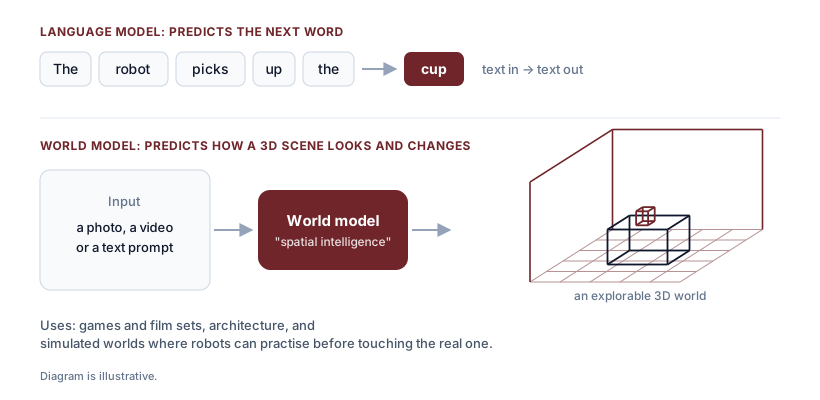
According to AMD, World Labs' models "generate, reconstruct and simulate interactive 3D environments from text, image and video inputs," and the company also works on robot learning and simulation. Its first product, Marble, creates 3D worlds from a prompt or an image. They can be used for entertainment and design, or as simulated environments where robots are trained.
Why would a chipmaker buy a model company?
AMD makes the processors and AI accelerators that models run on. Its explanation is that understanding the most demanding new AI workloads, including reasoning, robotics, simulation and what it calls "physical AI", will shape which chips it designs next. Owning a frontier research lab gives it that view from the inside rather than second-hand.
There is also a competitive reason. As TechCrunch notes, NVIDIA, AMD's main rival in AI chips, already publishes its own open world models, called Cosmos, while AMD had so far only released text and video models. Hardware makers increasingly compete on the whole stack: chips, software and the models that show those chips off.
Why it matters for robots
As we explained in Robotics: From Factory Arms to Humanoids and What Comes Next, one of the biggest obstacles to capable robots is data. Language models learn from trillions of words on the internet, but there is no internet of robot movements. World models offer a way around this: generate realistic 3D environments and let robots practise in simulation, millions of times, before they touch the real world. That is why world models are widely seen as essential for putting generative AI into autonomous vehicles, warehouse robots and humanoids.
What it means if you are learning AI
For the past few years, most of the attention in AI has gone to text. Deals like this suggest that the next wave will be about vision, 3D and the physical world. The skills behind it are computer vision, 3D geometry, simulation and robotics, combined with the same deep learning foundations used for language. Across the Middle East, universities such as MBZUAI and Khalifa University are already building research programmes in these areas (see our directory of AI institutes in the Middle East).
If you want to build these foundations, our Advanced Computer Vision and Introduction to AI in Robotics courses are good places to start.
What to watch next
- Whether regulators approve the deal, and whether it closes by the end of 2026 as planned.
- Whether World Labs' models, including Marble, stay available as products or become mainly a showcase for AMD hardware.
- How NVIDIA and other chipmakers respond in the race to own the "physical AI" stack.
Sources: AMD press release, 28 September 2026; TechCrunch.