26 September 2026 · By Hadi Ataei
Robotics: From Factory Arms to Humanoids and What Comes Next
Robots have been "just around the corner" for about a hundred years. For most of that time, the reality was much narrower than the dream: powerful, precise machines that did one job, over and over, behind a safety fence. That is changing. Over the past few years, the same kind of AI behind chatbots has started to give robots something they never had before: the ability to handle situations nobody programmed them for.
This article covers how we got here, where robotics actually stands in 2026, and where it could be headed.
A hundred years in one picture
Ideas (1920s–1950s)
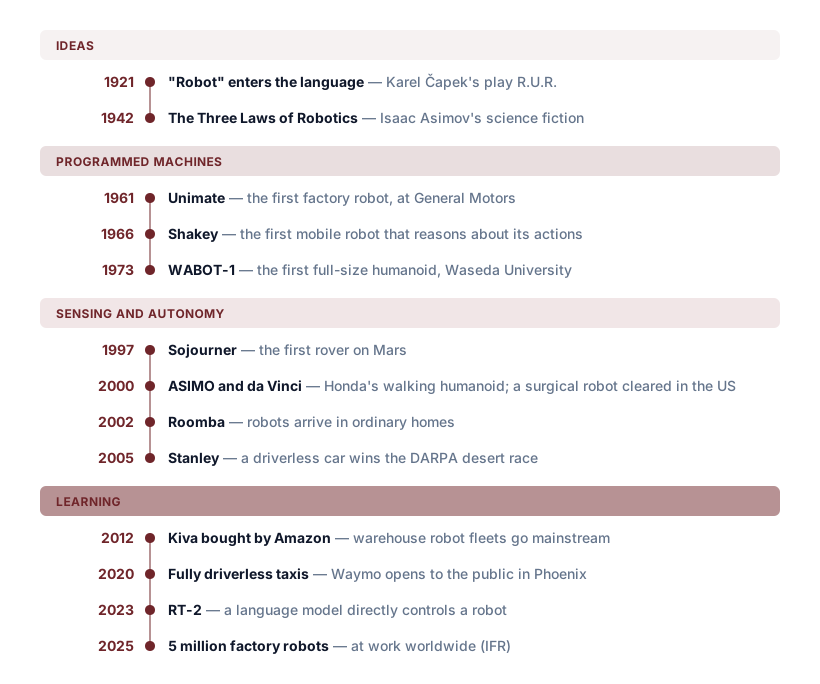
The word "robot" comes from the Czech playwright Karel Čapek, whose 1920 play R.U.R. (first staged in 1921) imagined artificial workers. It comes from robota, Czech for forced labour. Two decades later, the science fiction writer Isaac Asimov published his Three Laws of Robotics, and people have argued about how to make robots safe ever since.
Programmed machines (1960s–1980s)
The first industrial robot, Unimate, started work at a General Motors plant in 1961, lifting and stacking hot metal parts from a die-casting machine. It couldn't see or sense anything; it simply replayed a recorded sequence of movements. That idea turned out to be enormously valuable. Through the 1970s and 1980s, robot arms took over welding, painting and assembly in car factories, doing dangerous and repetitive jobs with a precision no human could match.
At the same time, researchers were trying something harder. Shakey, built at the Stanford Research Institute from 1966, was the first mobile robot that could look at its surroundings, reason about them and plan its own route. It was slow and clumsy, but it produced ideas still used everywhere, including the A* search algorithm that powers route-finding in maps and games. In 1973, Waseda University in Japan built WABOT-1, the first full-size humanoid robot.
Sensing and autonomy (1990s–2000s)
Cheaper sensors, faster computers and new mathematics for handling uncertainty let robots start working outside the factory. Sojourner became the first rover on Mars in 1997. In 2000, Honda unveiled its walking humanoid ASIMO, and the da Vinci surgical system was cleared for use in the US; surgical robots have since assisted in millions of operations, always under a surgeon's control. In 2002 the Roomba brought a robot into ordinary homes.
Self-driving cars took off in the same period. In 2004, the US defence research agency DARPA offered a prize for any driverless vehicle that could cross about 240 km of desert. None finished. A year later, Stanford's Stanley won, and several of the people behind it went on to found today's self-driving industry.
Qatar has its own chapter in this story. In the mid-2000s it pioneered robot jockeys for camel racing, small remote-controlled robots riding on the camels in place of the child jockeys they replaced, a use of robotics driven by human rights as much as technology.
Learning (2010s–today)
From around 2012, deep learning transformed how robots see. Neural networks could suddenly recognise objects, people and road scenes far more reliably than hand-written code. Amazon bought Kiva Systems in 2012 and turned its shelf-carrying robots into huge warehouse fleets. In 2020, Waymo opened fully driverless taxi rides, with no safety driver on board, to the public in Phoenix.
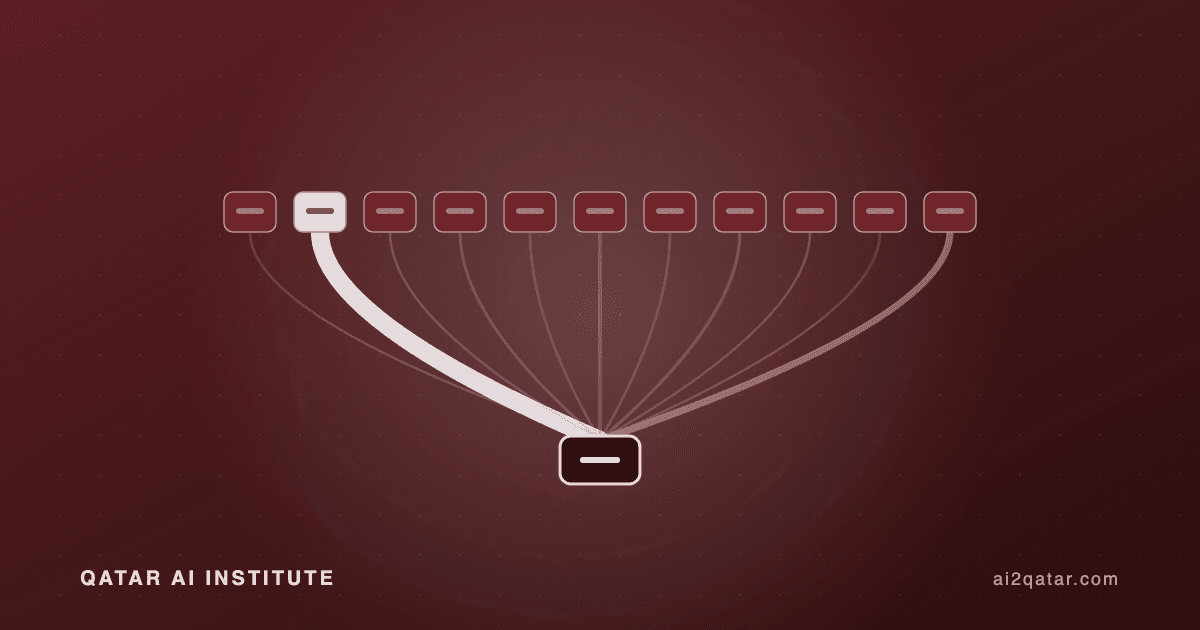
The biggest recent shift is in how robots decide what to do. For decades, a robot's software was a chain of separately engineered steps. Now, a single learned model can go straight from what the robot sees, plus an instruction in plain language, to how it should move:
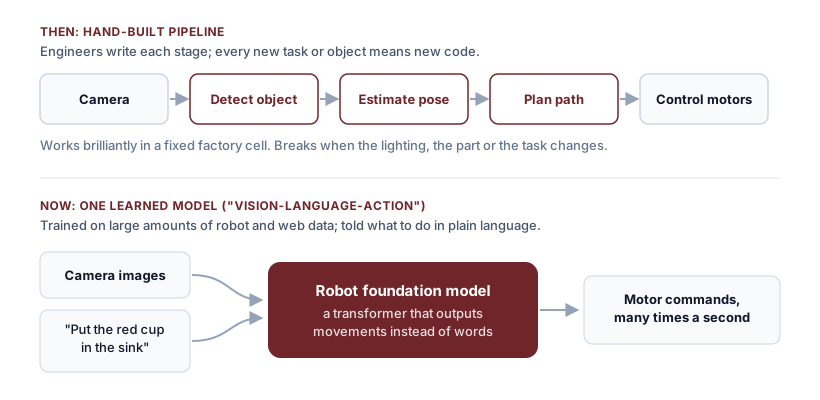
These are called vision-language-action (VLA) models. Google DeepMind's RT-2, in 2023, showed that a model trained on web images and text, plus robot data, could follow instructions it had never been trained on. Since then, Google DeepMind's Gemini Robotics, Physical Intelligence's π (pi) models, NVIDIA's GR00T and others have pushed the idea further. Under the hood, most are transformers, the same architecture behind chatbots, except that the output is movement rather than text.
Where robotics stands in 2026
The honest picture is uneven. Some kinds of robots are everyday infrastructure; others are impressive in videos but only just leaving the lab.
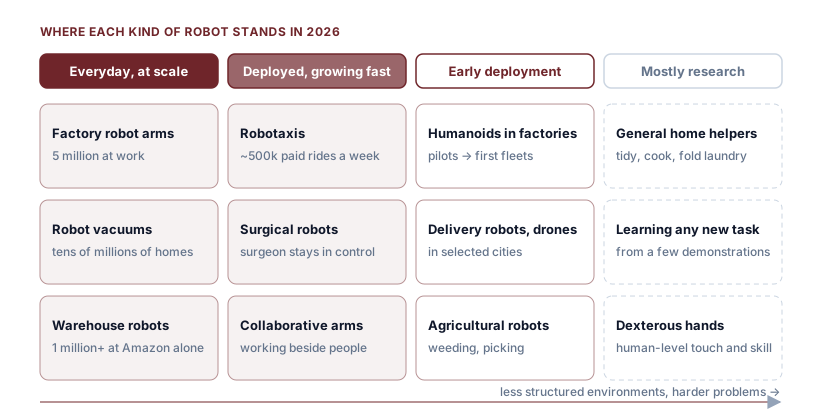
- Factories. According to the International Federation of Robotics, about 5 million industrial robots were at work worldwide in 2025, and more than 600,000 were installed that year alone. China accounted for 59% of new installations. A growing share are collaborative robots designed to work safely next to people instead of behind fences.
- Warehouses. Amazon alone runs more than a million robots across its fulfilment network.
- Roads. Waymo was giving around half a million paid, fully driverless rides a week across US cities by 2026, with a stated goal of one million a week by the end of the year, and has announced plans for London and Tokyo.
- Humanoids. This is the most hyped area and the least mature. Boston Dynamics' electric Atlas entered production in 2026, and its owner Hyundai has announced plans for 25,000 Atlas robots across Hyundai and Kia plants, with factory work beginning in 2028. Figure AI's humanoids have worked shifts on BMW's production line in South Carolina. These are real deployments, but they are still pilots and first fleets doing well-defined tasks, not general-purpose workers.
Why robotics is still hard
In the 1980s, the roboticist Hans Moravec noticed something now called Moravec's paradox: things that are hard for people, like chess or calculus, are relatively easy for computers, while things a toddler does without thinking, like picking up an unfamiliar toy, are extremely hard. That is still true.
- Not enough data. Language models learn from trillions of words on the internet. There is no internet of robot movements. Robot data has to be collected by people remote-controlling robots, generated in simulation, or learned from videos of humans, and all three are active research areas. (Simulation is one reason AMD is buying the world-model company World Labs.)
- The real world is messy. Lighting changes, objects are soft, slippery or broken, and people walk in front of the robot. A model that succeeds 95% of the time is a great demo and a poor product: in a factory that could mean a failure every few minutes.
- Hands and hardware. Human hands have remarkable touch and dexterity, and matching them in a durable, affordable robot hand is still an open problem. So are battery life and cost.
- Safety. A wrong answer from a chatbot is a bad paragraph. A wrong movement from a 60-kilogram robot next to a person is a much bigger problem, so robots need to be reliably safe, not just usually correct.
Robots learn from data, and a model is only as good as its data. That makes data preparation, explained in our step-by-step data preparation guide, as important in robotics as anywhere else in AI.
Where robotics could be headed
Predictions in robotics have a poor track record, so treat these as directions rather than dates:
- General-purpose robot "brains". The bet behind VLA models is the one that worked for language: train one large model on data from many robots and many tasks, and it becomes able to do tasks it was never shown. Early results suggest this works. The open question is how much data it takes, and how to collect it.
- Humanoids in structured workplaces first. Factories and warehouses have predictable layouts, repetitive tasks and a shortage of workers. That's where humanoids are being deployed now, and where they are likely to prove themselves before hospitals, shops and, much later, homes.
- Falling costs. Industrial robots got cheaper and easier to program with every generation, and the same is happening to mobile robots and humanoids, driven partly by large-scale manufacturing in China.
- Robots you talk to. Instead of programming a robot, you'll increasingly tell it what you want, in any language, and correct it the same way.
- Work that changes rather than disappears. Most robots so far have taken over tasks, not whole jobs, and created new ones: people who install, maintain, supervise and train them. How smoothly that transition goes will depend on training and policy as much as on technology.
For the Middle East, several of these trends fit local needs well: logistics hubs, inspection of oil, gas and utility infrastructure, healthcare, and outdoor work in extreme heat, where keeping people out of danger is a strong reason to automate. For more on how AI is already used across industries, see AI in Industry: Case Studies from Healthcare to Agriculture, and for the wider picture, The Future of AI: Five Trends and the Challenges Ahead.
Learning robotics
Modern robotics sits where mechanical engineering, computer vision and machine learning meet, and the machine-learning side is increasingly where the progress comes from. As we argue in Using AI Is the Baseline. Building It Is the Edge., the people who understand how these systems are built will be the ones deploying them.
Our Introduction to AI in Robotics course is the place to start, followed by Advanced Robotics and Advanced Computer Vision for the perception side.