
5 October 2026 · By Hadi Ataei
The White House "Super Intelligence Force": What It Is and Why It Matters

On Sunday, 4 October 2026, US President Donald Trump announced a new task force, which he named the "Super Intelligence Force", to coordinate the American federal government's response to artificial intelligence. It is a policy story rather than a technical one, but it will shape the environment every AI company, researcher and student works in, so it is worth understanding.
What was announced
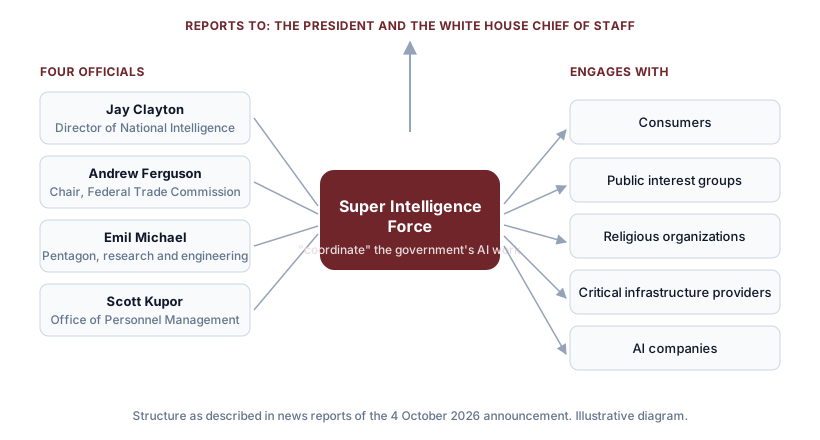
- Four officials lead the task force: Jay Clayton, Director of National Intelligence; Andrew Ferguson, chair of the Federal Trade Commission; Emil Michael, the Pentagon's under secretary for research and engineering; and Scott Kupor, director of the Office of Personnel Management.
- Reporting line: the force reports to the President and to White House chief of staff Susie Wiles.
- Mandate: according to the announcement as quoted by the press, it will coordinate the federal government's engagement with consumers, public interest groups, religious organizations, critical infrastructure providers and AI companies, so that the US keeps its lead in what Trump calls "Super Intelligence".
Why now
The announcement followed a White House meeting earlier in the week with executives from major AI developers, which news reports describe as including companies such as OpenAI, Anthropic, Google, Meta, Nvidia and SpaceX. Reports say the companies signed voluntary safety standards that include internal evaluations, third-party audits and board-level reviews, and that they agreed to meet regularly on standards and best practice. Trump described the arrangement as "self-policing". The Washington Post's headline tied the announcement to calls for an AI slowdown, and NBC reports that some tech leaders have themselves called for regulation.
Voluntary standards versus regulation
The central question is the difference between two approaches:
- Voluntary commitments: companies promise to test and audit their own models. This is flexible and fast, but nothing forces a company to keep its promise or to publish results.
- Binding regulation: laws that set requirements and penalties, such as the EU's AI Act. This is slower to write, but enforceable.
The administration has so far favoured the first approach, and reports note that some states, including California, have pursued their own AI rules instead. A federal coordinating body like this one does not by itself create new law; what it does depends on how much authority it is given and how it works with Congress, regulators and the companies.
Why it matters if you are learning or working in AI
Rules about testing, auditing and transparency end up as day-to-day engineering work: evaluating models for bias and safety, documenting training data, explaining a model's decisions. Those are the topics in our article Why Are AI Models Like Black Boxes?, and they are why AI ethics and evaluation are becoming core skills rather than optional extras. The same debate is under way across the Middle East, where governments are building AI strategies and institutes (see our directory of AI institutes in the Middle East), and where rules set in Washington and Brussels influence the companies whose tools local teams use.
If you want a grounding in these questions, our AI Ethics and Bias course covers fairness, accountability and how models are audited.
What to watch next
- What formal powers and budget the task force receives, and whether it publishes anything.
- Whether the voluntary standards are published in full and whether the third-party audits become public.
- How Congress and individual states respond, and whether binding federal rules follow.
Sources: CBS News; NBC News; CNN; The Washington Post, all 4 October 2026. This article is based on press reports; details may change as the White House publishes more.