13 October 2026 · By Hadi Ataei
Genesis Mission: $2.4 Billion in AI Compute Pledged for US Science
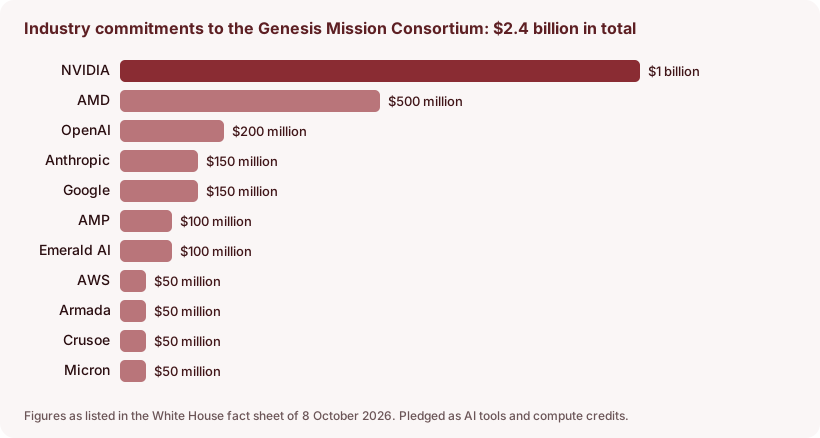
On 8 October 2026, at a White House summit called Science: A New Golden Age, the US administration announced a package of science initiatives it puts at more than $6 billion across the federal government, industry, academia and philanthropy. The part most relevant to AI is a set of pledges from eleven companies: $2.4 billion in AI tools and compute credits for the Genesis Mission Consortium, a Department of Energy (DOE) partnership that supports work at more than 15 federal agencies. This article explains what was announced, how to read the numbers, and why it matters if you follow AI.
What was announced
According to the White House fact sheet, the industry commitments are:
Alongside the pledges, the fact sheet lists other items. The ones most connected to AI are:
- Regional compute hubs: more than 14 universities across 10 states launched the Southeast Regional Computing Consortium to build and share large-scale compute for research, and universities, industry and the State of Georgia announced a $1 billion investment in scientific computing and workforce training.
- Instruments and labs: the National Science Foundation (NSF) and DOE announced over $100 million for AI-enabled scientific instruments and autonomous laboratories.
- Training scientists: a $100 million Genesis Mission Fellowship for accelerated four-year PhDs that combine AI with another science or engineering field, and a new six-year NSF bachelor's-to-PhD programme.
- Virtual cells: the NIH, DOE and Biohub launched a $1.8 billion initiative to build the data and models for "virtual cells", AI models meant to predict how cells respond to disease and treatment.
The fact sheet also covers space nuclear power, quantum computing competitions and new research institutions, which we leave aside here.
What the Genesis Mission Consortium is
The Genesis Mission is a DOE programme, launched under a presidential executive order, that aims to use AI to speed up scientific discovery. The DOE announced the Genesis Mission Consortium earlier in 2026 as a public-private partnership of the department, the National Laboratories, companies and universities. It is administered by TechWerx, a DOE partnership intermediary run by RTI International, and it organises member-led working groups on AI model development and validation, data integration and standards, high-performance computing and cloud infrastructure, and robotics and automation.
The October pledges are therefore contributions to an existing structure, not a new programme: companies offer tools and compute, and federal agencies and researchers work on shared science challenges.
How to read the numbers
- "Tools and compute credits" are not cash. A credit is the right to use a company's computing or software. Its real worth depends on how it is priced and how much of it researchers can use. The fact sheet gives the totals, not how they are valued.
- The $6 billion is a headline total that adds federal, industry, academic and philanthropic commitments, and some of it builds on commitments announced in July. Not all of it is federal money.
- This is the administration's own account. The figures come from the White House's fact sheet. We have not seen an independent audit of what has been delivered.
- "Super intelligence". The fact sheet uses the term "super intelligence" (SI) throughout for AI used in science. In the part of the document we read, it is not defined. Treat it as the administration's branding, not as a technical category.
One disclosure: Anthropic, whose Claude models we sometimes mention on this site, is among the eleven companies on the list, with $150 million.
Why it matters
The pattern is worth noticing. The scarce resource in modern AI research is compute, and universities and public labs often cannot afford as much as the large companies have. This package is one way of moving some of that compute to public research. Whether it works depends on access: how easily a researcher outside a top lab can actually use the credits.
It also shows where AI is being pointed. Money for virtual cells, autonomous labs and AI-focused PhDs signals that governments see AI as a tool for science itself, not only as a product. The same idea runs through our article on AMD's purchase of World Labs, where AMD, one of the pledgers here, agreed to buy a company building models of the physical world, and through our report on the White House AI task force.
What it means if you are learning AI
AI for science is a growing career path that combines machine learning with a field such as biology, chemistry or physics. The fellowship in this package is built on exactly that mix. If you want to move in that direction, start with the foundations in Machine Learning Fundamentals and pick a science field you care about. Readers in the Middle East can see a similar mix of public programmes and training in our guide to where to study AI in Qatar, Saudi Arabia and Dubai, which includes national bodies such as SDAIA.
What to watch next
- How the pledged credits are allocated, and whether researchers outside large labs can use them.
- Whether the consortium publishes results, such as models, datasets or discoveries, that others can check.
- How the dollar value of the credits is counted as the programme reports progress.
Sources: White House fact sheet, 8 October 2026; US Department of Energy: Genesis Mission Consortium.